
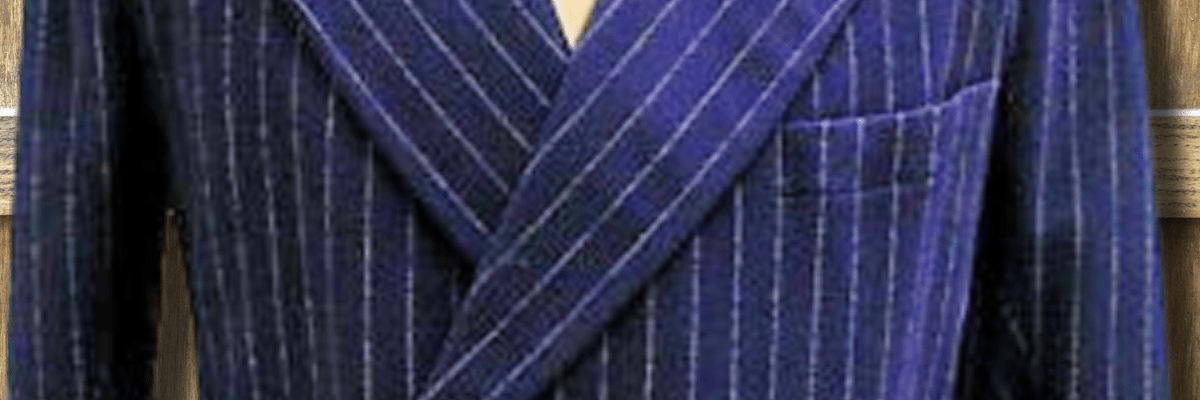
Frederick Scholte is often heralded as the originator of the Drape suit and the London Cut / English-style tailoring, the style that has come to define Savile Row. A Dutchman, Scholte emigrated to the United Kingdom in 1880 at the age of 15 or 16. He apprenticed as a tailor, working with the Household Cavalry where he cut military uniforms to the exacting standards of the officers of The Life Guards, The Royal Horse Guards and The Royal Dragoons which then comprised the Household Cavalry and today are better known as The Blues and Royals and The Life Guards. These regiments were historically associated with the nobility, with many of their officers being commissioned from the upper echelons of society. These officers would have deep pockets and high expectations. Scholte would have needed to produce pieces to meet these specifications, with many of the officers using their bespoke uniforms as a means of demonstrating wealth and status and informally competing with one another to be the best presented. Scholte quickly earned a reputation as an outstanding tailor, whose craft was sought out by various members of high society outside of the military. He established his own workshop in the late 1890s and took on a number of apprentices, including Per Anderson who would go on to found his own atelier, Anderson & Sheppard. Scholte’s eye for an exquisite suit, borrowing from the military silhouette but giving a more relaxed, elegant look earned him an envious client list, including the Prince of Wales (later King Edward VIII, becoming the Duke of Windsor on his abdication), an icon of men’s style. The studio ceased trading on Scholte’s death in the 1940s but the occasional vintage piece still attracts great interest and many are featured in museums and galleries.
FREDERICK SCHOLTE
F. SCHOLTE

Frederick Scholte is often heralded as the originator of the Drape suit and the London Cut / English-style tailoring, the style that has come to define Savile Row. A Dutchman, Scholte emigrated to the United Kingdom in 1880 at the age of 15 or 16. He apprenticed as a tailor, working with the Household Cavalry where he cut military uniforms to the exacting standards of the officers of The Life Guards, The Royal Horse Guards and The Royal Dragoons which then comprised the Household Cavalry and today are better known as The Blues and Royals and The Life Guards. These regiments were historically associated with the nobility, with many of their officers being commissioned from the upper echelons of society. These officers would have deep pockets and high expectations. Scholte would have needed to produce pieces to meet these specifications, with many of the officers using their bespoke uniforms as a means of demonstrating wealth and status and informally competing with one another to be the best presented. Scholte quickly earned a reputation as an outstanding tailor, whose craft was sought out by various members of high society outside of the military. He established his own workshop in the late 1890s and took on a number of apprentices, including Per Anderson who would go on to found his own atelier, Anderson & Sheppard. Scholte’s eye for an exquisite suit, borrowing from the military silhouette but giving a more relaxed, elegant look earned him an envious client list, including the Prince of Wales (later King Edward VIII, becoming the Duke of Windsor on his abdication), an icon of men’s style. The studio ceased trading on Scholte’s death in the 1940s but the occasional vintage piece still attracts great interest and many are featured in museums and galleries.
SINCE 1890s | DUTCH / ENGLISH / BRITISH | PREMIUM LUXURY HERITAGE BRAND
LONDON
BESPOKE | TAILORS



*Please note that this article contains affiliate links.
Discover more from FITZGABRIELS
Subscribe to get the latest posts sent to your email.
 FITZGABRIELS
2 thoughts on “FREDERICK SCHOLTE”