
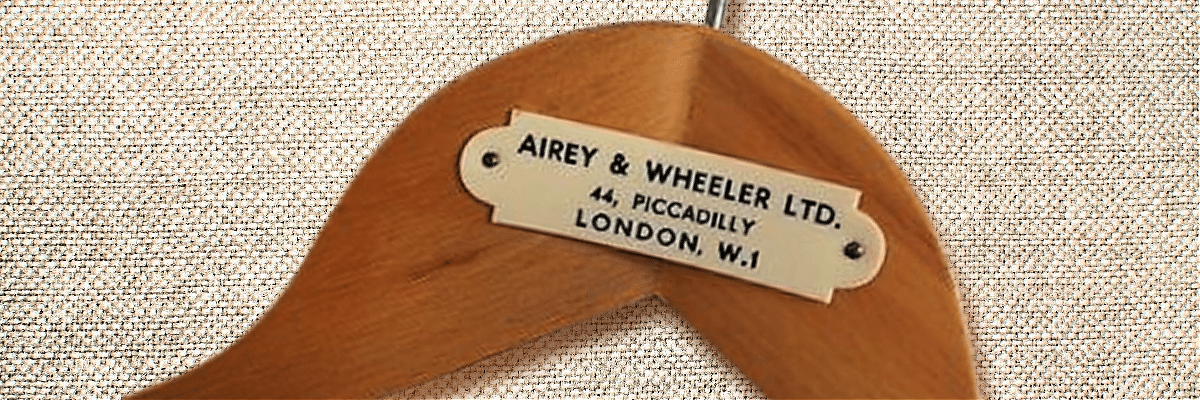
Legendary tropical weather tailor and a Savile Row institution, albeit located off-Row in Piccadilly, Airey & Wheeler was the first-choice tailor for distinguished gentlemen and military officers seeking lighter weight suits and tailored pieces for warmer climates, including the much-dismissed London summertime. Famous patrons of the House include a number of former Prime Ministers, Sir Winston Churchill and Sir John Major amongst them. The firm remained under the control of the founding Airey family until 1996 when it was acquired by and incorporated into the house of Anthony J Hewitt, itself now under the watchful eye and stewardship of renowned master tailor, Ravi Tailor.
LET’S GO SHOPPING…

PURCHASE FROM
AIREY & WHEELER
USE THE LINKS BELOW



Tracing back to its foundation in 1883, Airey & Wheeler was established by James Airey as a traditional, full-service, bespoke tailoring house in London‘s Savile Row area, operating from 129 Regent Street for much of its history and certainly into the 1960s. The firm prospered and slowly accumulated a very respectable book of clients, many of whom were reliable as repeat customers, keeping the house doing a very tidy trade.
As part of the Airey & Wheeler offering, many clients would commission lightweight suits cut from tropic weight wools (8oz and 10oz wools), cotton or linen as opposed to the traditional worsted wools and tweeds that had come to define Savile Row and the English style. These clients were typically in the employ of the foreign and imperial service, the armed forces or international businesses and were located or about to be dispatched to overseas posts in warm and tropical climes. They would find themselves in colonial outposts in hot and humid regions with all the expectations, social standards and social engagements that would have defined their lives in the United Kingdom.
The traditional woollen suit was too warm, too stifling and too cumbersome to be practical in such conditions. These customers wanted the Savile Row experience, with its appropriate formality, structured shoulders and refined drape, but with tropic-friendly adaptations. Local tailors in those jurisdictions simply could not match the expectations of these clients.
Up to the 1950s, Airey & Wheeler had become an internationally renowned maker of elegant, lightweight suits and tailored apparel that was perfectly suited to such environments. The house produced a range of garments to order for its illustrious clients, from safari jackets, sportswear and summer suits. They made suits for senior figures throughout the colonies and in the far flung trading posts that had come to define the New World. Their suits were an essential for the best-dressed travellers crossing to the Pacific or the Caribbean on the great ocean liners. Their apparel draped the silhouettes of the great explorers and expedition voyagers who sought to map new territory in the deepest jungles of the Southern hemisphere in the name of European powers.
Their international patronage expanded the firm’s knowledge and know-how with respect to new materials. Few firms outside of the Southern United States were experimenting with seersucker. Airey & Wheeler did too. Madras as well and lighter cottons from Egypt, Sea Island and other renowned regions. Their well-tailored, lightweight suits were functional and unrestrictive, allowing ease of movement for their customers whilst also remaining cool. Indeed, one might say that they were Airey by name and airy by nature.
The house’s expertise with these fabrics and suit constructions was demonstrably evident but did not yet define their business into the 1930s when the ivory linen dinner jacket became a global hit as a warm-weather alternative to the traditional dinner jacket (and the American tuxedo variant). Airey & Wheeler customers would keep the firm busy with requests for such formalwear and additional pieces to allow them to enjoy the events to which they were accustomed, dressed appropriately and agreeably.
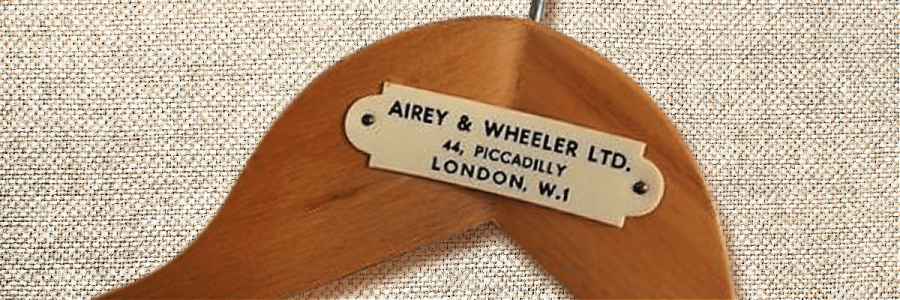
In 1957, the firm made a strategic decision to pivot to offering tropical tailoring as their primary market and acquired a premises in Piccadilly. Eventually, the firm would consolidate at this new home which would come to be referred to as “Tropiccadilly”. This move would galvanise the firm’s reputation as a tailor of distinction and they would see their client base grow to become the envy of their Savile Row peers. The firm also began to put out a ready-to-wear range to accommodate their more urgent customers. By 1960, the firm counted five men of the Airey name in its partnership. A true family business and, as such, most of its clients would refer to the brand as simply “Airy” or “Airey’s”.
Many distinguished patrons would pass through the doors to the firm’s Tropiccadilly studio, including former Prime Ministers, Sir Winston Churchill and Sir John Major. Many famous names from politics, diplomatic service, journalism, show business and the arts would come to the tailoring house for their tropical suits and would carry their reputation with them on their worldly tours. The famed correspondent and former Member of Parliament, Martin Bell OBE, who came to be known as “the man in the white suit” was a vocal fan of Airey & Wheeler and an Airey & Wheeler suit would often be referred to as the unofficial uniform of British ambassadors. The firm would find its name being mentioned in diplomatic and political circles across the world and soon became a preferred outfitter to many African politicians and tribal princes.
The firm would use those connections to seek partners in Africa who could support their ambitions to grow their ready-to-wear ranges as they sought to become an outfitter beyond a traditional tailoring house. They worked with a number of textiles factories across the continent, including Rex Trueform and Steegan. They would also experiment with modern, synthetic materials, often more suitable to hotter climates.
Visitors to Airey & Wheeler’s Piccadilly showroom could pick up all manner of accessories, neckties, shirts and so on. The firm also looked to its American rivals Willis & Geiger and Abercrombie & Fitch who had cornered a substantial part of the market in safari apparel and expedition gear and began to offer a British alternative to a global market. Similarly, Airey & Wheeler’s label could be found on luxurious sportswear to compete with the likes of Kent & Curwen.
Despite the brand’s grand standing amongst the world’s well-dressed gentlemen, the firm’s fortunes would begin to reverse from the 1980s and onwards. The end of the age of empire, the advent of affordable air travel, the rise of highly capable local tailors (many of whom trained on Savile Row after graduating from the Tailor and Cutter Academy), and the decline in formal events and their requisite dress codes would impact on demand for bespoke tailoring or even ready-to-wear tropical apparel.
In 1996, under the stewardship of Anthony Airey, a qualified barrister and master tailor, the firm would be forced to explore future options or close down. Another famous Anthony on the Row would offer to buy out the firm and bring the label under his own, Anthony J. Hewitt (A.J. Hewitt). The brand would continue as a ready-to-wear tropical and sportswear line until Anthony Hewitt would transfer ownership of his own house to his trusted protegée, Ravi Tailor. Under Ravi Tailor, Airey & Wheeler’s name would appear on bespoke pieces on occasion when a commission would request the same. Ravi would travel regularly, to his native Zambia, to India and far eastern markets and to the United States where he maintained a healthy client book.
In 2005, Tailor agreed an unusual partnership with Evisu, the iconic Japanese denim brand, which would see AJ Hewitt studio becoming an Evisu store offering a bespoke service under the Airey & Wheeler brand. This arrangement soured however with Ravi Tailor ultimately being forced out and taking his tailoring service with him, operating from the studios of L.G. Wilkinson. Airey and Wheeler Ltd was, sadly, dissolved in 2010.
Nonetheless, the brand is still a popular label for collectors and for the most exquisitely dressed men. Vintage pieces can be found regularly on eBay, for example.
This great house had a profound impact on the world of men’s fashion and the future direction of sartorialism. Not alone did they change the game in respect of lightweight suiting and travel wear, they also apprenticed a great deal many of the most famous names to ever ply their trade on Savile Row, including Jonathon Quearney, Adam Savvides of 40 Savile Row and Frazer Haart.
Lamentably, there appears to be no plans to reinstate this storied and legendary brand. For now, we can only share our memories of the Airey & Wheeler brand and we invite you to do the same in the comments below.
RECOMMENDED READING
CONTACT INFORMATION
WEBSITE:
EMAIL:
TELEPHONE:
STORE LOCATIONS MAP
CORPORATE INFORMATION
COMPANY NAME:
Airey and Wheeler ltd
PARENT COMPANY / OWNER:
A.J. Hewitt
STOCK SYMBOL:
–
AIREY & WHEELER
A&W / AIREY / AIREY’S

Legendary tropical weather tailor and a Savile Row institution, albeit located off-Row in Piccadilly, Airey & Wheeler was the first-choice tailor for distinguished gentlemen and military officers seeking lighter weight suits and tailored pieces for warmer climates, including the much-dismissed London summertime. Famous patrons of the House include a number of former Prime Ministers, Sir Winston Churchill and Sir John Major amongst them. The firm remained under the control of the founding Airey family until 1996 when it was acquired by and incorporated into the house of Anthony J Hewitt, itself now under the watchful eye and stewardship of renowned master tailor, Ravi Tailor.
SINCE 1883 | ENGLISH / BRITISH | PREMIUM LUXURY HERITAGE BRAND | aj-hewitt.co.uk
LONDON
ACCESSORIES | BESPOKE | MENSWEAR | OUTFITTERS | READY-TO-WEAR | SAFARI WEAR | SPORTSWEAR | TAILORS
A.J. HEWITT
*Please note that this article contains affiliate links.
Discover more from FITZGABRIELS
Subscribe to get the latest posts sent to your email.
 FITZGABRIELS